
Smaller stocks have emerged as Dalal Street's favourites in 2023 that has turned out to be a "great year" for equities, rewarding investors with big gains, driven by optimism over the country's macroeconomic fundamentals and heavy retail investors participation. Experts said equity markets are experiencing a prolonged bull run and it is during this time that the midcap and smallcap segments tend to outshine their larger counterparts. Till December 22 this year, the BSE smallcap gauge has jumped 13,074.96 points or 45.20 per cent while the midcap index has surged 10,568.18 points or 41.74 per cent.


'Chinese real GDP growth is 7.1% and India's is 7.4%'.

An industry survey has showed that economic growth for the current fiscal may slip to 4.8 per cent from 5 per cent estimated earlier.

'There are occasions when the prices of individual items like food raise inflation; then supply-side measures must be taken.' 'But if there is continued inflation, it means liquidity is aggravating the situation.'

Bringing in the untapped informal sector into the formal one will benefit business.

'Such big falls are quite frequent these days, so do not try to time this market.' 'Use big dips to accumulate quality stocks.'
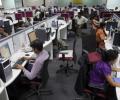
JP Morgan has downgraded the Indian information technology sector to 'underweight' as it believes the heydays of the sector are over. Rising margin headwinds in the near-term and the revenue headwinds in the medium-term from a potential macro slowdown, Ankur Rudra and Bhavik Mehta of JP Morgan said in the report, will mean that the sector's earnings upgrade cycle is behind. "We see peak revenue growth behind us and earnings before interest and taxes (EBIT) margins trending down from inflation, mean revision.

'Indians are basically liked because they are educated, they are intelligent.'

Renowned agricultural scientist M S Swaminathan and the driving force behind the nation's 'Green Revolution,' passed away in Chennai on Thursday.

'Instead of doing reforms and restructuring, the present government is busy with the perception that everything is fine and the economy is hunky-dory.' 'Such hollow perceptions are very dangerous for the Indian economy in the long run.' 'The real risk to India is the lack of decent employment opportunities for youth in general and educated youth in particular.'
Analysts assert that Vedanta Group's plan to demerge India-listed Vedanta Limited into six listed entities will not resolve the debt problem of its promoter entity, Vedanta Resources (VRL). They suggest that additional asset sales or stake sales by promoters will be necessary to repay the debt. Vedanta is already considering the divestment of its iron-steel division and its copper plant.

'I don't think we have ever seen such alignment of everything that we need in the banking sector.'

oreign Policy magazine named him as one of the world's top 100 global thinkers in 2011.

'Earlier-than-expected tapering from the US, followed by rate hikes, and locally, a potential third wave, which mimics the second wave in terms of severity.'

Weaker-than-expected growth in US jobs in recent months had already forced US central bankers to put off a rate hike at their meeting last week

Studies suggest net benefits of hydro-power, nuclear energy or natural gas as sources of electricity are greater than those of wind and solar.

The population is important and so is the talent, he said about China, the world's second-largest economy after the United States.

Slowing growth and execution challenges for Cognizant (CTSH) may well allow Infosys to overtake the former after a decade. Cognizant had marched ahead of Infosys in terms of revenue in the first quarter of financial year 2012-13. The Nasdaq-listed IT services firm's performance in Q3 and the guidance for Q4 and full-year 2022 suggest that it could take time for Cognizant to see the expected improvement in performance from its decision to restructure.

Top losers in the Sensex pack included IndusInd Bank, Yes Bank, SBI, L&T, Tata Steel, M&M, Bajaj Finance, Vedanta, Tata Motors and RIL, tumbling up to 6.97 per cent.

Investors are sceptical that the economy could have picked up so much steam.

World's 300 largest metropolitan economies account for nearly half of global economic output.

Sales expansion also down 4.4%

Portfolio returns, say analysts at Morgan Stanley, are more likely to be driven by bottom-up stock-picking rather than top-down macro forces.

The government on Tuesday announced Rs 900-crore allocation in the Budget for the newly set up Ministry of Cooperation for the 2022-23 fiscal, besides slashing Alternate Minimum Tax (AMT) on cooperative societies to 15 per cent and surcharge to 7 per cent, which nodal minister Amit Shah hailed saying it will boost the sector. Of the total allocation for the next fiscal, a significant amount of Rs 350 crore has been provided for digitisation of Primary Agriculture Cooperative Societies (PACs), while Rs 274 crore for an umbrella scheme 'Prosperity through Cooperatives' which would have a number of sub-components with the aim of all-round development of cooperatives in the country. For the first time, a separate budget of Rs 11 crore has been provided to Vaikunth Mehta National Institute of Cooperative Management (VAMNICON).

Poor earnings show in the September quarter (Q2FY24), with hints of likely weakness in asset quality going ahead, forced analysts to cut earnings estimates of SBI Cards and Payment Services (SBI Card). On the bourses, shares of the State bank of India arm tumbled 7.4 per cent to Rs 732 apiece on the BSE in the intraday trade as investors factord in near-term concerns. Analysts at Motilal Oswal Financial Services, for instance, slashed SBI Card earnings by 8 per cent and 10 per cent for FY24 and FY25, respectively, as they expect the company to face pesistent magin pressure.
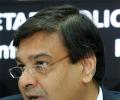
Chetan Ghate, Pami Dua and Ravindra Dholakia have been appointed for 4 years

This analysis is based on the quarterly earnings for 724 companies.

A way out of the economic slump is to revisit the template of 15 years ago and follow its constituents, recommends Ajay Shah.

Poor quality of education is one of the most important reasons for high unemployment in India, says Kavita Nigam.

ICICI Bank was the top gainer in the Sensex pack, surging 4.64 per cent, followed by Axis Bank at 3.86 per cent and SBI 2.53 per cent.

A group of current and retired faculty members at the Indian Institute of Management-Bangalore (IIM-B) has asked leaders of corporate India to "de-fund" the spread of misinformation and hate speech through news channels and social media.

'It will be best for investors to have a systematic investment plan in mid-cap and small-cap funds with a three-/five-year horizon.'

What's different this time is that global financial stress -- which has its genesis in four policy choices made in recent years -- is juxtaposed with a more resilient real economy, observes Sajjid Z Chinoy, chief India economist at J P Morgan.

India's services sector activities touched the highest mark since April 2011 amid ongoing improvements in demand conditions, even as cost pressures in the service economy remained stubbornly high, a monthly survey said on Tuesday. The seasonally adjusted S&P Global India Services PMI Business Activity Index rose from 58.9 in May to 59.2 in June -- its highest mark since April 2011. For the eleventh straight month, the services sector witnessed an expansion in output. In Purchasing Managers' Index (PMI) parlance, a print above 50 means expansion while a score below 50 denotes contraction.

However, the Indian economy is expected to bounce back in 2021, the World Bank said.

"We work with other countries to develop their capabilities and support their efforts to make free sovereign choices. More broadly, we aim to advance peace and stability in the region," he asserted.
Some say the MPC will raise the rate, while others are of the view that there is already de facto interest rate tightening through rising bond yields, which might prompt the central bank to go for a pause.

Ratings agency Moody's on Tuesday affirmed India's sovereign rating and upgraded the country's outlook to 'stable' from 'negative', citing receding downside risks to the economy and financial system.

'So you have welfare programmes, you reach out to the poor, you cut out the middlemen, you cut out the leakages and you try to raise the standard of living.'
